Begin Anywhere
You don’t have to see the whole staircase. Just take the first step.”
— Martin Luther King Jr.
This worksheet helps you reflect on what matters to you, explore where you can make a difference, and identify one small action to take this week.
1. What Moves You
We all respond to the world differently. The issues that catch your attention, the moments that frustrate you, the topics you can’t let go of — none of that is random. Our reactions are shaped by the lives we’ve lived, the environments we’ve worked in, the responsibilities we carry, and the experiences that formed our perspective on the world.
Some things make you tense. Others make you curious. Some spark protective instinct, while others leave you feeling flat. These emotional cues help you understand what matters to you. Social change work is much easier when you start from the issues that feel personally meaningful, not the ones you think you should care about.
This exercise is simply an invitation to notice those signals. Think about the moments in your daily life when you feel a pull — a “that’s not right,” a “that should be different,” or a “why does no one talk about this?” Think about the stories that linger with you for longer than they should, or the conversations that stay in your head hours after they’ve ended.
These moments point to the topics where your interest, instincts, and energy naturally gather. That’s where it makes sense to begin.
🧭 Prompt: “When I look at the world around me, I wish more people cared about…”
2. Mapping the role you play in different spaces
Think about the different spaces you move through — family, friendship circles, work, community, online — and the roles you naturally step into. These roles may not be formal or chosen; often they’re inherited, learned, or reinforced by the dynamics around us. These spaces will look different across cultures – family networks, diaspora communities, faith spaces, local organising groups, online communities or workplaces.
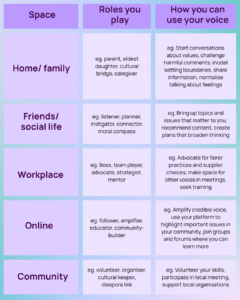
In the example table below is a list of some of the spaces many of us occupy in our day to day lives. Think about each of these spaces in the context of your own life. Who is in them? What role, skills, or special relationships/ influence do you hold in them? Every role you identified carries potential influence — even if it feels small. Understanding the role you play helps you show up intentionally in different situations.
🟢 Exercise: Draw your own table listing the spaces relevant to you in the first column, and the role you play in those circles. There are some examples in the table below to help you.
3. Using Your Roles as Leverage for Change
Think about what you know about each space: Who listens to you? Where do you set the tone or have specific influence? Where do your opinions ripple outwards? Where do you have access others don’t?
Now, using the same table, write how you could use your presence or voice in each role.
🧭 Prompt: Let’s have a quick 5 minute reflection on Quiet Power:
Quiet power is the strength found in introversion, self-control, and thoughtfulness, allowing individuals to lead, influence, and create change through deep listening, empathy, and impactful, intentional actions rather than dominance or noise. Quiet power redefines strength and influence through the lens of inner depth, strategic silence, and authentic presence, making it a valuable asset in leadership, work, and life. Look back at your table and think about where you may hold quiet power and how it might shape the role you play in different spaces. Add to the table as needed.
4. Start Small, But Start
Now reflecting on the table and the ways in which you could leverage the role you play in different circles – choose one action you can take in the next 7 days. (You don’t have to get it right — you just have to get started.)
Examples:
- Share an article that helped you understand an issue better
- Have a conversation with a friend or colleague about something that matters
- Follow 3 new accounts that inform and inspire you
- Donate, sign, or volunteer — even once
- Reflect privately by writing about your values or experiences
- Support a community-led initiative, grassroots organiser or local mutual-aid group
- Challenge a stereotype or bias you’ve internalised
🧭 Prompt: “One small act I can take this week is…”
5. Reflect & Repeat
After one week, take a moment to notice:
How did it feel to take that action?
What did you learn about yourself?
What might you try next?
Progress about consistency.
Keep Going
If you enjoyed this reflection, explore:
And remember, every movement anywhere in the world began with ordinary people taking one small deliberate step.